
Stories from the lab
Lizard backpacks: wearable sensors for ecology and evolution in the wild
What does a lizard do when nobody is watching? For almost the entire history of field biology, we simply could not know. Ultra-lightweight wearable sensors are changing that.
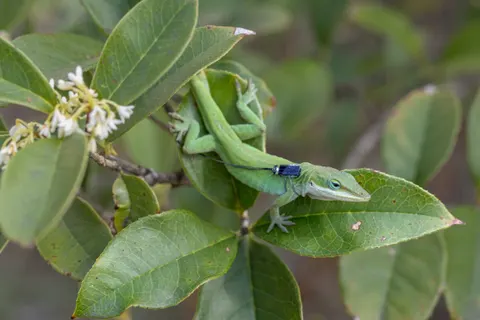
Field biologists are very good at snapshots. On Lizard Island we catch every anole twice a year, measure it, mark it and let it go, and from those snapshots we can measure natural selection with real precision. But what happens in between (the months a lizard spends moving through the canopy, defending a territory, finding a mate, or sitting out a cold night) has stayed almost entirely out of view. And watching a lizard does not solve the problem: it watches you back, and its behavior changes the moment an observer arrives.
Wearable sensors close that gap. A tiny tag, fitted to a free-living lizard like a backpack, records movement, behavior, physiology and interactions passively, around the clock, with nobody standing nearby. Indeed, these are data types that eco-evolutionary field studies have simply not had before.
Why put a backpack on a lizard?
Because behavior is the hinge between ecology and evolution. Natural selection acts on what animals do, not only on what they look like, yet most studies of selection in the wild measure morphology and survival and infer everything in between. Does a longer-legged anole survive because it runs faster, or because it uses different perches? Do individuals in the same population use their habitat in consistently different ways, and does selection care? Sensors let us ask these questions directly, linking the behavior of individual lizards to their survival and reproduction, and in doing so connecting process to pattern.
The same logic applies to thermal ecology. Our work on green anoles suggests that behavior, rather than physiology, is what has allowed a lizard of tropical origin to push north into temperate Tennessee and North Carolina (see the green anole guide). Sensors that record where and when a lizard moves through the winter let us test that idea on individual animals, as it happens.
Built at Georgia Tech
Georgia Tech is one of the best engineering and computer science universities in the world, and we are an evolutionary ecology lab inside it. Building our own wearable sensors is one of the clearest ways we take advantage of that. In 2026 Georgia Tech funded the next phase of the program, together with our colleagues Ben Freeman and Emily Weigl in the School of Biological Sciences. The campus itself has become our test bed: we are fitting green anoles on the Georgia Tech campus in Atlanta with ultra-lightweight trackers, and extending the same approach to butterflies and birds.
A track is only as useful as the map underneath it. Our annual terrestrial LiDAR scans of Lizard Island record the location and size of every branch on the island, so a tagged lizard's movements can, in principle, be placed on the branches it actually used. We expect that pairing the two will let us measure how individuals use their structural habitat at a resolution no field study of selection has had, revealing which parts of the environment selection is acting through. The data streams are large, which is why we write our own software to process them.
We are confident that instrumenting organisms in the wild is the future of ecology and evolution. If you want to put backpacks on lizards (they look adorable, obvs), get in touch.
More stories from the lab
Story
Falling iguanas
After Miami's coldest night in a decade, six lizard species converged on the same new cold limit.
Story
Lizard Island
A decade of measuring natural selection on every lizard on one small island in Miami.
Story
Sleepy Lizard Project
Counting sleeping green anoles at night to learn how their behavior changes across the seasons.
Story
Three-legged lizards
Lizards missing a whole leg can run, grow and survive as well as the rest.