
Software & tools
What we build
We are entering a new generation of how we can study ecology and evolution. Our lab focuses on two major innovations: automated pipelines that use machine-learning techniques to process data at unprecedented speeds and scales, and advanced instrumentation of field biology using sensors for passively collecting data in the wild. We developed most of the tools below to facilitate our lab's specific research needs, but built them to be customizable and broadly useful to biologists.
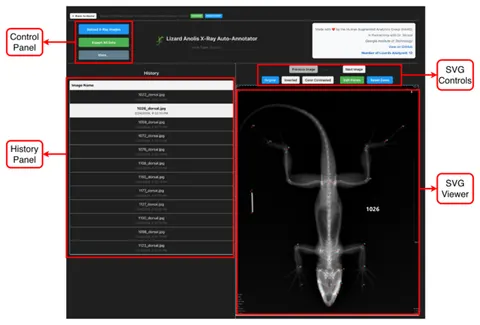
Automated Morphometric Landmarking
ML-Morph Web
A generalizable machine learning framework for automated anatomical landmark detection in digital images. Built to landmark the lab's lizard radiographs and toepad scans without a person clicking every point, but written to generalize beyond them.
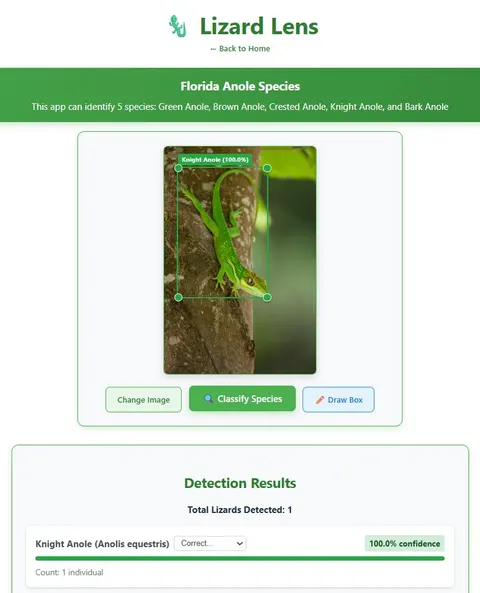
Automated Species identification
LizardLens
A two-stage deep learning pipeline for identifying anoles in photographs. A fine-tuned YOLOv8x model finds each lizard in the frame; a Swin Transformer then classifies it. Trained on 10,000 verified iNaturalist photographs across five Florida anole species, it reaches 83.0% top-1 accuracy and an F1 of 0.890, beating the best single-stage YOLO model by 10.5 to 13.2% on every metric. Splitting detection from classification is what buys the improvement: each stage specializes.
LizardLens was built for middle school students in the Lizards on the Loose program. Species identification is ordinarily the barrier that keeps non-experts out; here it becomes the entry point. Students get probability-ranked predictions instead of a guess, correct the bounding box by hand when the model is wrong, and each validated prediction becomes a real iNaturalist observation.
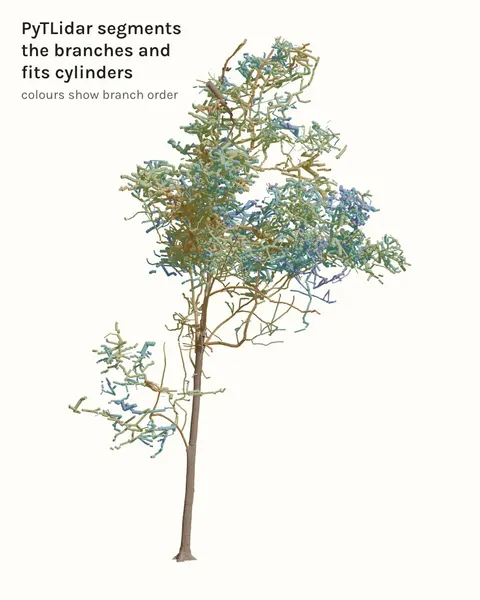
Structural Environment Quantification using LiDAR
PyTLidar
A Python package for building quantitative structure models of trees from terrestrial lidar point clouds. We use it to measure the branches on Lizard Island: perch diameter and perch height are the axes anole ecomorphs are built around, and until now they were measured by hand, one branch at a time.
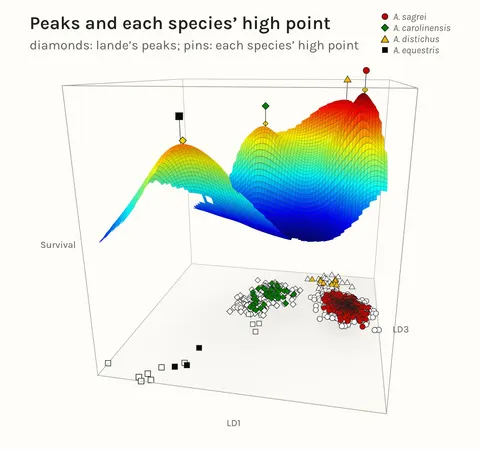
Toolbox for Natural Selection Analyses
lande
An R package for analyzing and visualizing natural selection, in development in the lab.
Why this matters to the lab
Georgia Tech is one of the best engineering and computer science universities in the world, and we are an evolutionary ecology lab inside it. That is not an accident of geography we intend to waste. Wearable sensors, lidar, and deep learning give access to data types that eco-evolutionary field studies simply have not had before, opening questions that were previously unanswerable rather than merely tedious.
Much of this work is done with Master's students from the OMSCS program and with undergraduate capstone teams from Electrical and Computer Engineering, who have designed and built hardware for us as well as software.