
Stories from the lab
What happens to tropical lizards when Florida freezes
On the night of 22 January 2020, Miami dropped to 4.4°C (40°F), its coldest in a decade. Six lizard species came out of it tolerating colder temperatures than before.
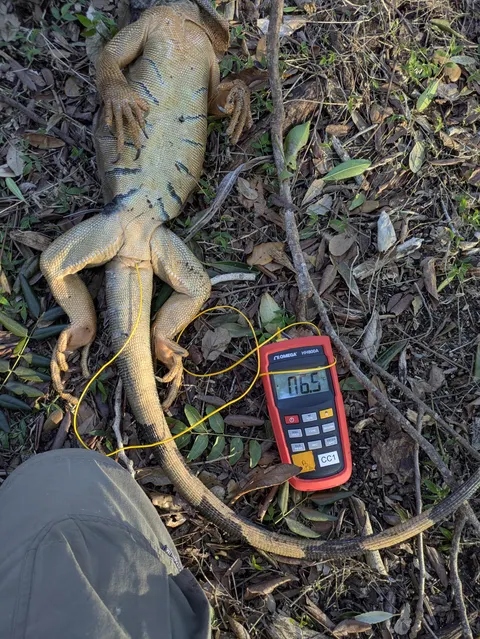
South Florida's lizards come mostly from the tropics, and every one of them has a lower limit: a body temperature at which it can no longer turn itself the right way up, known as its critical thermal minimum. On 22 January 2020, air temperatures in Miami fell below the limits of the lizards living there.
We happened to be ready for it. In October and November 2016 we had measured the cold tolerance of six lizard species living together in Miami: four anoles (the green, brown, crested and bark anoles), the brown basilisk and the African house gecko. They differ in size, habitat and physiology, and before the cold snap their cold limits differed too.
Six species, one new limit
In the week after the freeze we measured all six species again. As a community they could now tolerate colder temperatures, and species that had differed beforehand had converged on the same new, lower limit, averaging about 7.2°C. Ten weeks later the new limits were still in place in the five species we could resample (COVID-19 curfews ruled out night sampling for the house gecko).
How does a lizard's cold tolerance change so fast? Two explanations are possible, and they are not mutually exclusive. The cold may have killed the least tolerant individuals, leaving a population shaped by selection, or the survivors may have adjusted their physiology in response to the cold itself. Either way, the result cuts against a common assumption: tropical and subtropical cold-blooded animals are often thought unable to withstand rapid swings in climate, yet these lizards endured conditions beyond their measured physiological limits.
Back out in the cold
Extreme cold events keep coming. When another hit Miami in February 2026, the lab was out at 4am, in winter hats and head torches, ready to sample cold-stunned lizards. A study with colleagues on how lizards lose, and then recover, the ability to move after cold exposure is currently in review. It connects to our research on green anoles further north, where surviving winter is the central challenge for a lizard of tropical origin (see the green anole guide).
The 2020 study, led by James Stroud and Caitlin Mothes, was published in Biology Letters.
In the news
- The Washington Post Florida cold temperatures pose risk to people, crops and iguanas
- CNN Florida's falling lizards are getting used to cold winter temperatures
- Scientific American It's so cold in Florida that iguanas might rain from the skies
- Smithsonian Magazine Lizards Fell From Palm Trees During a Florida Cold Snap, but Now They've Toughened Up
- Science News How frigid lizards falling from trees revealed rising cold tolerance
- Phys.org What cold lizards in Miami can tell us about climate change resilience
Read the research
More stories from the lab
Story
Lizard Island
A decade of measuring natural selection on every lizard on one small island in Miami.
Story
Sleepy Lizard Project
Counting sleeping green anoles at night to learn how their behavior changes across the seasons.
Story
Three-legged lizards
Lizards missing a whole leg can run, grow and survive as well as the rest.