
Lizards of Miami · Introduced from Cuba and the Bahamas
Brown anole (Anolis sagrei)
By far the most abundant lizard in Miami, and now found from Florida to islands in the middle of the Atlantic.
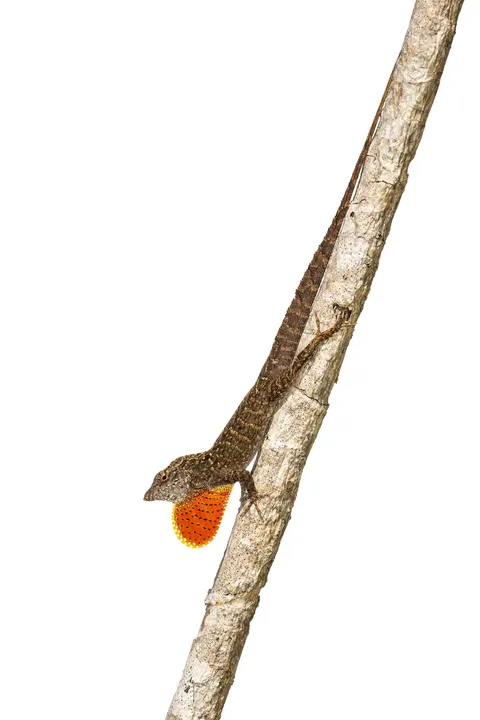
At a glance
- Scientific name
- Anolis sagrei
- Native to
- Cuba and the Bahamas
- Size
- Similar to the crested anole; males larger than females
- Dewlap
- Red-orange in males, sometimes with a yellow border or yellow blotches
- Where to look
- On the ground and low on tree trunks, walls and fences (up to about 1.5 m), often in full sun
If you have seen a lizard in Miami, it was probably a brown anole. The species comes from Cuba and the Bahamas and has spread across the entire state of Florida and far beyond it. In 2018 we reported the first brown anoles on Ascension Island, in the middle of the Atlantic, and on Bermuda its arrival poses a new threat to the critically endangered Bermuda skink.
Brown anoles love the sun and are among the few anoles active through the hottest part of the day. They are also the champion displayers of the group. Watch any tree trunk for a few minutes and a male will fan his dewlap, bob his head and do push-ups, a message to other males that this trunk is taken.
City lizards
Brown anoles thrive in cities, and part of the reason is behavioral. When we compared males in urban and natural forest habitats in Miami, urban lizards perched on broader surfaces, used walls and other human-made structures, jumped less and changed perches less often. They also displayed their dewlaps more than twice as often. Urban sites were more open, with roughly a third of the tree density, so a displaying lizard can be seen from further away, which may explain the jump in signaling.
Losing ground to a newcomer
On Lizard Island, our long-term study site in Miami, brown anoles made up 75% of all adult anoles in October 2017. Then the Puerto Rican crested anole arrived. Four years later brown anoles were just 18% of the community, and the number of adult males had fallen from 168 to 54. Where the two species live together across Miami, brown anoles perch lower and spend more time on the ground, and on Lizard Island natural selection began favoring brown anoles with relatively longer hind limbs, the build that suits running on broad, open surfaces. The full story is on our Lizard Island page.
Brown anoles also appear in another story from the lab: a three-legged brown anole in the Bahamas started the project described on our three-legged lizards page.
How to tell it apart
- Always some shade of brown, and never green (a green anole can turn brown, but a brown anole cannot turn green).
- Two dark bars above the eyes, and no pale ring around the eye or pale stripe above the front leg (both of which the crested anole has).
- Females usually carry a pattern of diamonds, bars or a stripe down the back; crested anole females have only a plain cream stripe.
- Males display constantly: dewlap out, head-bobs and push-ups, often in the middle of a hot day.
Our research on the brown anole
- Observing character displacement from process to pattern in a novel vertebrate community. Nature Communications (2024)
- Behavioral shifts with urbanization may facilitate biological invasion of a widespread lizard. Urban Ecosystems (2019)
- Onward to the Mid-Atlantic: First records of Cuban Brown Anoles (Anolis sagrei) on Ascension Island. IRCF Reptiles & Amphibians (2018)
- Establishment of Anolis sagrei on Bermuda represents a novel ecological threat to Critically Endangered Bermuda skinks (Plestiodon longirostris). Biological Invasions (2017)
- Hurricane effects on Neotropical lizards span geographic and phylogenetic scales. Proceedings of the National Academy of Sciences (2020)
- Fluctuating selection maintains distinct species phenotypes in an ecological community in the wild. Proceedings of the National Academy of Sciences (2023)
Identification details follow our field identification guide to the anole lizards of Miami. Spotted one? Photograph it and add it to iNaturalist.