
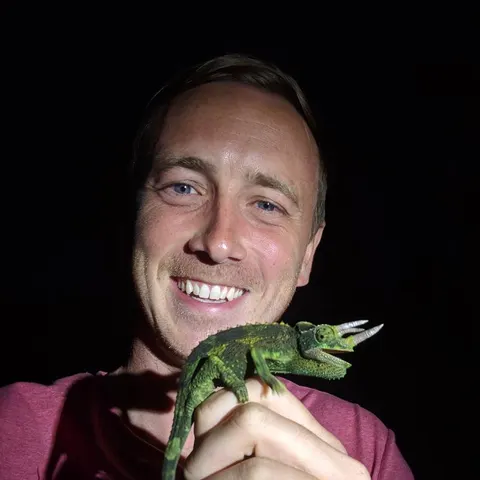
Evolutionary ecologist
James T. Stroud, Ph.D.
Principal Investigator, the Stroud Lab, School of Biological Sciences, Georgia Institute of Technology
James Stroud studies how natural selection operates in the wild, and how those short-term processes add up to the patterns of biodiversity we see across space and through time. Nearly all of his work is built on lizards, mostly Anolis lizards (anoles), a group of more than 400 species whose ecology has been documented across 40 million years of diversification. In 2015 he founded Lizard Island, a long-term field study in Miami where every lizard on a 6,000 square meter island is caught and measured twice a year, connecting evolution measured in real time to the large-scale patterns it is meant to explain.
Originally from London, James studied Zoology at the University of Wales and Ecology at the University of Hull, then moved to Miami for a PhD in Ecology and Evolution at Florida International University (2018). He was a postdoc with Jonathan Losos at Washington University in St. Louis from 2018 to 2023, and started the Stroud Lab at Georgia Tech in 2023.
Research
The lab's questions sit where ecology and evolution meet: how natural selection acts on whole communities rather than single species, how lizards cope with thermal extremes and a changing climate, and how new species colonizing a community reshape the ones already there.
Selected papers
- Long-term studies provide unique insights into evolution. Nature (2025)
- Observing character displacement from process to pattern in a novel vertebrate community. Nature Communications (2024)
- Fluctuating selection maintains distinct species phenotypes in an ecological community in the wild. Proceedings of the National Academy of Sciences (2023)
Honors
- Bicentenary Medal, Linnean Society of London (2026)
- Atwood Rising Star in Evolution, University of Toronto (2026)
- Packard Fellowship in Science and Engineering (2025)
- Maxwell/Hanrahan Award in Field Biology (2025)
- Founder's Prize, British Ecological Society (2024)
- Early Career Fellow, Ecological Society of America (2024)
- Fellow of the Linnean Society of London (2024)
- Early Career Investigator Award, American Society of Naturalists (2021)
Writing and press
- It's so cold in Florida that iguanas might rain from the skies, Scientific American, January 2026
- 'Pirate Lizards' Can Get Around on 3 Legs, The New York Times, October 2025
- These 'Pirate Lizards' Thrive With Three Legs, Smithsonian Magazine, October 2025
- What the secret lives of lizards tell us about evolution, The Washington Post (by James Stroud), March 2025
- 'Pirate lizards' can adapt to survive on just three legs, Science, 2025
- 'Living Fossil' Lizards Are Constantly Evolving: You Just Can't See It, Scientific American, May 2024
- Florida cold temperatures pose risk to people, crops and iguanas, The Washington Post, January 2022
- Florida's falling lizards are getting used to cold winter temperatures, CNN, October 2020
James Stroud elsewhere
Georgia Tech profile Google Scholar ORCIDX (@jamesTstroud)The Conversation ResearchGate GitHubWikidata