
Welcome to the Stroud Lab at Georgia Tech!
The Stroud Lab is led by James Stroud, an evolutionary ecologist at Georgia Tech who studies how lizards evolve in the wild.
We are an evolutionary ecology lab built on a single premise: ecology and evolution are not separable. Our central ambition is to bridge the process-pattern divide, connecting ecological and evolutionary dynamics measured in wild populations to the large-scale patterns of diversity that emerge across continents and clades.
Most of this work happens in the field. We combine targeted sampling of populations with long-term mark-recapture studies that measure natural selection directly, letting us ask how selection shapes the phenotypes we observe. Nearly all of our work uses lizards, mostly Anolis lizards (anoles), at field sites across the southeastern United States (especially Florida), the Caribbean, and Central and South America.
To do this, we integrate behavioral, computational, genomic, biomechanical, and physiological approaches, pairing field data with theoretical models and large-scale comparative datasets. Back at Georgia Tech, we are developing machine-learning tools for high-throughput phenotyping and for quantifying the structural environment, and building our own wearable sensors to record behavior passively in the wild. Welcome to the world of lizard backpacks!
Solving the biodiversity crisis will require understanding not just which species exist, but why they live where they do and how rapidly they can respond to a changing world.
You can read more about our research on the Publications page!
The long-term evolutionary field study
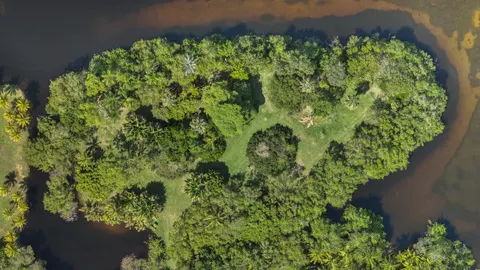
Lizard Island
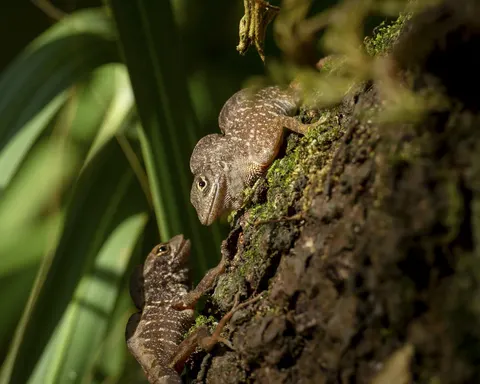
For over a decade, we have been measuring natural selection in the wild on the entire anole community of a small island in Fairchild Tropical Botanic Garden (Miami, Florida). Originally, the community consisted of four species: a semi-terrestrial specialist (the Cuban brown anole, Anolis sagrei), a tree trunk specialist (Hispaniolan bark anole, Anolis distichus), and two arboreal canopy specialists (the native American green anole, Anolis carolinensis, and the "crown-giant" Cuban knight anole, Anolis equestris). In late 2017, a fifth species joined the community: the Puerto Rican crested anole (Anolis cristatellus), another semi-terrestrial specialist, and we have been watching its evolutionary battle with the resident brown anole population ever since. On Lizard Island, there are approximately 800 to 1,000 lizards at any given time; we return every spring (May/June) and every fall (Oct/Nov), which lets us measure selection separately through the summer reproductive season and the winter non-reproductive season.
More on the Lizard Island study
Long-term field studies measuring natural selection in multiple species are relatively rare: the most famous example is Peter and Rosemary Grant's exceptional 40 year field study of Darwin's finches on Daphne Major in the Galapagos . On Lizard Island, we are trying to emulate that study: already, it is now one of the longest-running active field studies in the world measuring natural selection on an entire multi-species community. You can read all about other, famous long-term evolution studies in a review that we recently published: