
Lizards of Miami · Native
Green anole (Anolis carolinensis)
The only anole native to the United States, and the lizard behind the old nickname “American chameleon.”
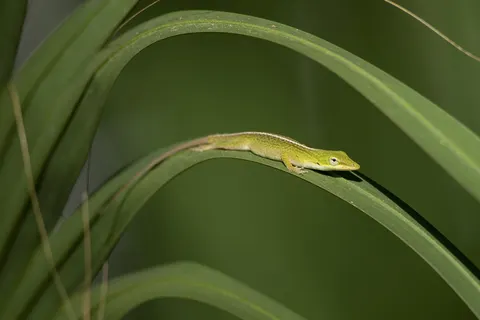
At a glance
- Scientific name
- Anolis carolinensis
- Native to
- The southeastern United States; its ancestors reached Florida from Cuba
- Size
- Males up to 7.5 cm (3 in) snout to vent; females somewhat smaller
- Dewlap
- Bright pink to reddish, mostly in males
- Where to look
- Up in trees and shrubs, and on houses and fences; usually higher than you are looking
Every other anole you see in Miami was brought here by people, deliberately or by accident, from islands across the Caribbean. The green anole got here on its own, and a very long time ago: its ancestors crossed from Cuba to Florida roughly 5 to 7 million years ago, and the species now reaches as far north as Tennessee and North Carolina, far beyond the tropics where its relatives live.
Its color-changing trick earned it the nickname “American chameleon,” a misnomer that has mostly fallen out of use. Green anoles eat mainly small insects, although they have also been seen licking nectar from flowers. They will take bigger prey when it comes along: in August 2018 we caught an adult male in the University of Miami's Gifford Arboretum part-way through swallowing a juvenile African house gecko.
Where did all the green anoles go?
People who grew up in the southeast often remember green lizards on the porch that seem scarcer now. They are not imagining it, but the story is not one of simple replacement. Where brown anoles arrive, green anoles tend to move upward into the canopy rather than disappear, so the lizards are often still there, just above eye level.
A tropical lizard in a temperate world
How does a lizard from tropical Cuba end up living through Tennessee winters? That question sits at the center of our work on green anoles at Georgia Tech, which happens to be perfectly placed along the species' range. Our initial work suggests that changes in physiological cold tolerance are not what made the range expansion possible: lower thermal limits differ surprisingly little across the range, especially set against how much the climate itself varies. Behavior seems to be what changes. Where winter air temperatures drop below what green anoles can tolerate, they stop living only in trees and move down into sheltered refuges underground, sidestepping the cold rather than evolving to withstand it.
We follow green anoles through the seasons, counting them at night for our Sleepy Lizard Project (57 lizards in 60 minutes on the first survey of fall 2026) and, on the Georgia Tech campus in Atlanta, fitting some with ultra-lightweight wearable sensors that record movement and behavior on free-living animals. Green anoles were also one of six species whose cold tolerance shifted after south Florida's extreme cold snap in January 2020, a story told on our cold snaps page.
How to tell it apart
- Bright green, but it can turn dark brown. Green anoles can turn brown; brown anoles can never turn green.
- A longer, pointier snout than any other anole in Miami.
- Displaying males raise a crest along the head and neck and show a black patch between the eye and the ear opening.
- Females have a pale line running down the middle of the back.
- The only other all-green anole in Miami, the Jamaican giant anole, is larger and has a yellow dewlap rather than a pink one.
Our research on the green anole
- An extreme cold event leads to community-wide convergence in lower temperature tolerance in a lizard community. Biology Letters (2020)
- Hemidactylus mabouia (African Wood Slave). Predation by Anolis carolinensis (American green anole). Herpetological Review (2020)
- First specimen of an American green anole (Anolis carolinensis) on the oceanic island of Bermuda, with a review of the species' current global distribution. IRCF Reptiles & Amphibians (2016)
Identification details follow our field identification guide to the anole lizards of Miami. Spotted one? Photograph it and add it to iNaturalist.